

Decision-First: Thriving When AI Executes and Humans Choose

As AI takes over, what remains uniquely human is the power to choose.
That’s what will determine success or failure.
It’s a massive shift. Until recently, ideas were cheap and execution was everything.
But in the age of AI, it’s all different. Now playbooks are learned and explained in seconds by ChatGPT, agents can execute anything on a computer, and robots will soon handle the rest in the real world too.
What remains truly scarce?
Choices. Navigating a tree of decisions. And letting AI execute on those decisions.
If your judgment was right, you succeed. If not, you fail. That’s the new world.
And that’s why more and more people are studying the art and science of making decisions.
Here, I’m looking at what people are saying on the topic as it helps us design Jupi.
Today’s case: Tackling tough decisions head-on (Stripe, 2024)
A 40-minute conversation between Angela Strange, General Partner at Andreessen Horowitz, and Yin Wu, CEO of Pulley. You can watch it here.
It’s worth watching in full, but here are three takeaways that stood out to me.
1. Decision-Making Takes the Spotlight
Pulley, a competitor to Carta, helps startups manage their cap tables. What caught my attention is that they use the language of “decision-making” twice on their homepage tagline and subtitle.
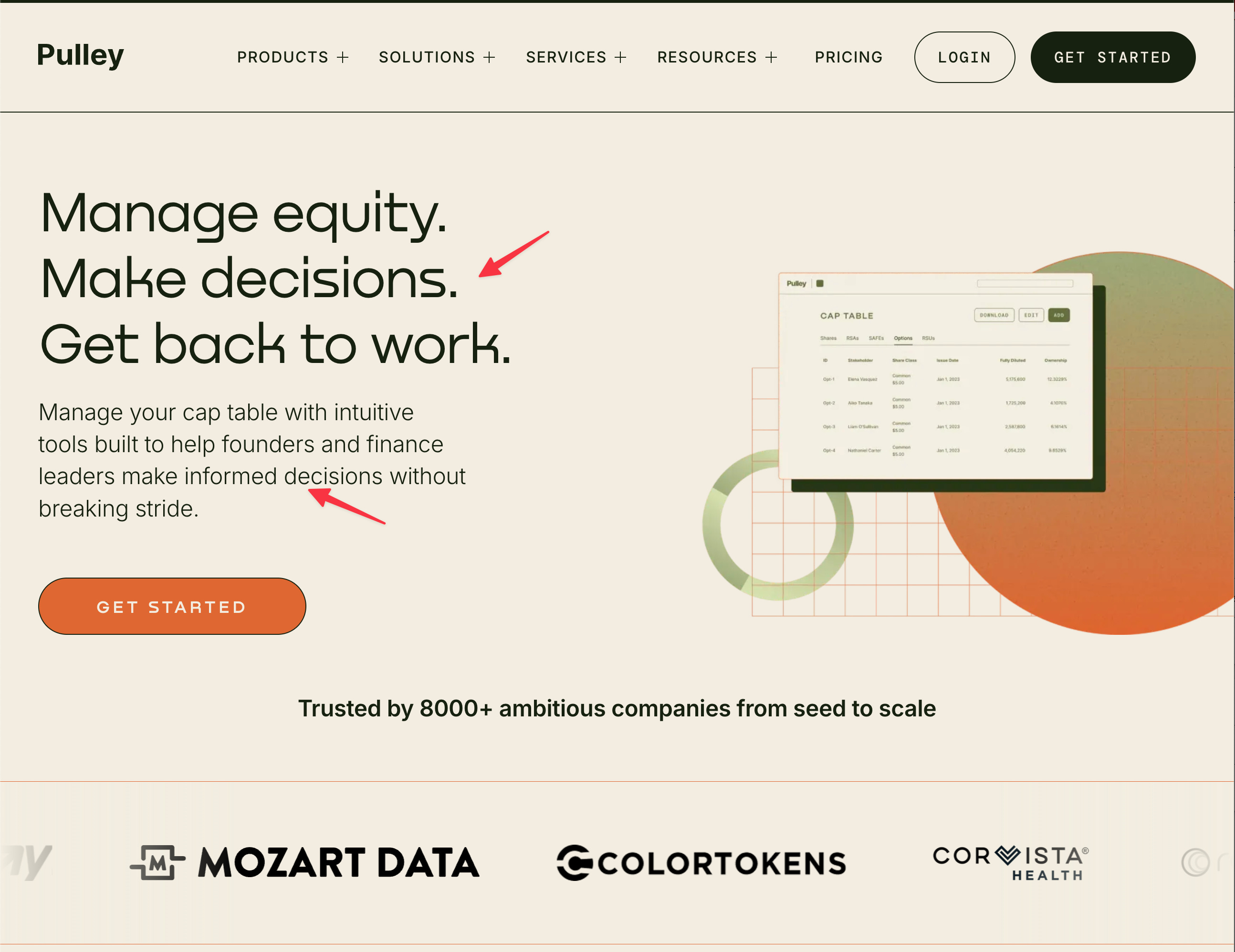
The world is becoming decision-first. I love it.
2. “Conviction, Not Consensus.”
Consensus gets a bad reputation, and rightly so.
“One of our values is conviction, not consensus. Because at the end of the day, the founder is the lifeblood of the company.”
The idea that founders must have conviction rather than follow consensus resonates.
Building something new means believing in something that most people currently don’t.
If your idea is easy to agree with, it’s probably already being built elsewhere and you’ll end up competing in a red ocean where commoditization kills you.
In today’s AI world of hyper-saturated innovation, total commoditization, and hyper-competition, winning demands bold, contrarian decisions.
But there’s nuance here.
Two key nuances:
Not everything should be contrarian. Your core initial differentiation should be, yes, but not every operational choice needs to defy consensus. Founders often hear the founder mode story and start reinventing every wheel: culture, hiring, GTM, board structure, and everything else… as if contrarianism itself were mandatory for success. It’s not. For everything outside your unique “why we’re different,” adopt best practices. They exist for a reason: they’re fast, safe, and efficient.
Conviction is a phase, not a permanent state. Early on, conviction is your only edge. But once you’ve proven your insight and competitors start copying you, you need to build a moat (data, distribution, brand, network effects…). Contrarian bets get you started; systems and advantages keep you compounding and accelerating.
So while I admire Pulley’s conviction not consensus principle, I don’t know if I would make it a permanent cultural value.
It should definitely be an obsession for the founders in the early phase, but not for the whole organization and not forever. So not in the culture docs and values, I’d say.
As Yin Wu says, “the founder is the lifeblood.”
Last, consensus is often soft, especially when it requires a majority vote or any other majority-led process. Yet groups are smart. And smarter than individuals. There are many other ways to benefit from the collective intelligence of a group, and we’ll explore them later here.
But regarding consensus specifically, what efficient groups often do is follow a model called decision by silent consent or consent-based decision-making. It means moving forward when the owner of a topic has a strong conviction, and no one raises a strong objection (or they’ve all been answered). It’s efficient and blends collective wisdom with decisive leadership. That form of consensus actually combines collective wisdom with the conviction of a leader. And it doesn’t mean the leader can’t move forward even when some objections remain…
3. Great decisions are made fast
“One thing I’ll say that may be counter to common advice: whether your company succeeds or not depends on you and your exec team. Even with great investors, if you’re only making decisions quarterly at board meetings, you’re falling behind.”
In the early stage of a startup, quarterly or even monthly board meetings won’t move the needle. Most investors aren’t even pretending to be there to create value: they’re on the board mainly to see if you’ve nailed PMF and if they should write a bigger check to secure more ownership before other VCs do. Anyway, I don’t think board members will help a startup crack anything pre-PMF, and they don’t need to be involved in key decisions except maybe financing ones. Informed? Yes. Involved? hmm.
Regarding speed and making decisions quickly, I love what’s said here.
From Jeff Bezos to Elon Musk and many successful leaders I’ve met, every high performer shares this principle: make decisions quickly. Musk famously disrupted the rocket industry with SpaceX by launching more often. Even for such a heavy industrial process as building, launching, and landing rockets, speed beats perfection. Each failure is a faster feedback loop. Frequency beats precision.
Make. Decisions. Faster.
It requires a team aligned on that principle: we make calls fast, and that matters more than anything else.
I’ll stop here for today. But I really love what Yin Wu is saying and I’ll definitely write a follow-up, because there’s a lot more worth unpacking in that Stripe talk.
Execution is automated.
Judgment isn’t.
The age of execution is over and the age of decisions has begun!
Didn't expect this take on decision-making as the ultimate human diferentiator. But how do we prepare students to make truly informed and ethical choices with so much AI assistance?